
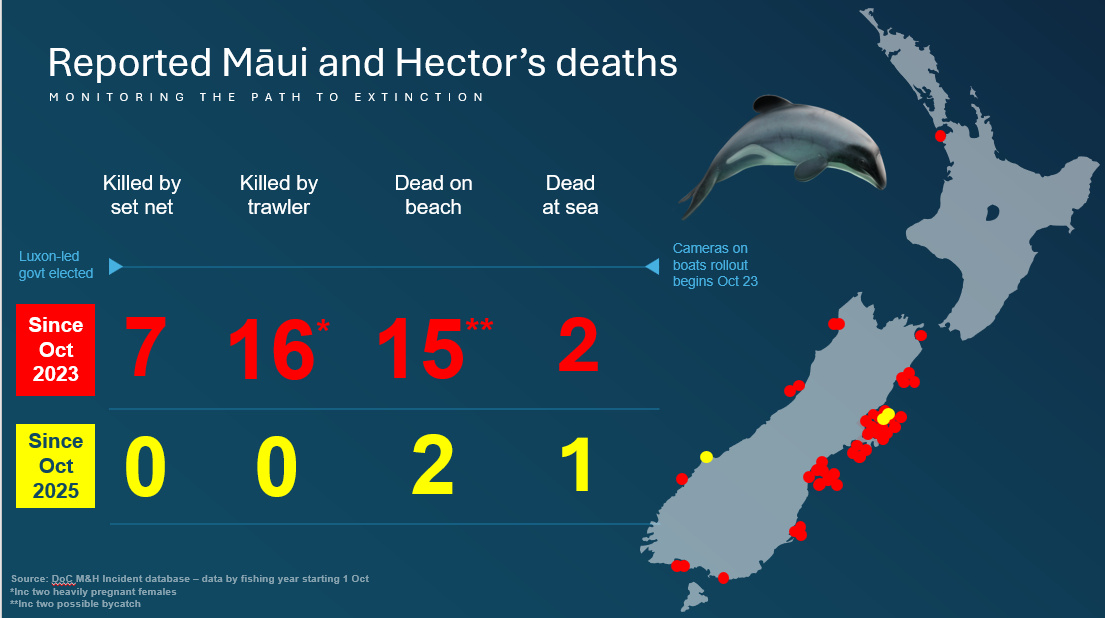
This mortality tracker is an extinction watch tool. It records deaths that are listed on the Department of Conservation Māui and Hector’s dolphin Incident Database. It only includes dolphins that have been reported, and uses DoC and Fisheries NZ information.
In the year before onboard cameras there were two dolphins reported dead in trawl nets. Since the roll out of cameras, there have been at least 19 (to March 2025). A 500% increase. The onboard camera roll out shows that in the 2024 fishing year, Hector’s dolphin deaths from the trawl fishing industry were almost five times the 2022 year’s total figure and more than half again on top of the 2023 total.
The 2025 fishing year started on Oct 1 2024 and s at least four dolphins have been killed in set nets that fishing year. A heavily pregnant female and another female were killed in set nets off Kaikoura, and another heavily pregnant female with her unborn female calf were killed by a trawler in Pegasus Bay in September 2025. This kills not just this generation but also the next, and the next and the next. Timaru is a real death zone for Hector’s dolphins, with another one (the seventh since September 2023) killed in January 2025. A dolphin was also killed in Te Waewae bay in February.
The 2025 fishing year also proved to be a sad one for beachcast dolphins, with a high number reported. Among these are neonates, or young dolphin calves, attributed to ‘natural causes’ and ‘maternal separation’. It is not known what caused that separation however. What happened to their mothers? The Māui & Hector’s Dolphin Incident database noted that at least two of the beachcast deaths could have been killed by fishing. We have taken the conservative approach and included them as beachcast, but either way, the fishing industry deaths are possibly underestimated.
In early March 2025, a small Hector’s dolphin calf was also found 2km out from Lyttelton Harbour, showing signs of what are thought to be injuries from a boat strike. The dolphin was killed, but its body was not returned to shore, so while we have photos, no necropsy was able to be performed.
Also in March, a female dolphin was reported dead on the beach at Big Bay, Westland. Cause of death is yet to be determined, and though she was not very healthy when she died, she was nursing a calf. it’s interesting to note that there are no cameras on trawlers or set netters on the West Coast of the South Island at this stage, and very limited protection for Hector’s dolphins there.
In April, a dolphin killed in a set net was added to the database tables. This dolphin was killed out of Timaru in December but inadvertantly not added to the table summaries. The dolphin’s body was thrown overboard.
The fishing industry continues to kill more Hector’s dolphins than any other known cause.