
To protect the Hector’s Dolphins of Akaroa Harbour and ensure their ongoing existence, Dolphin Defenders and the signatories to this petition recommend to the Department of Conservation, the following:
- Speed reduction zones focused on the Akaroa Marine Reserve
- Permanent continuance of the current moratorium on issuing permits for dolphin focused tourism in Akaroa Harbour.
- Review of the current limits on commercial tourist vessels in Akaroa Harbour.
- Give effect to a sinking lid on commercial tourist vessels
- Enforcement of the limits on commercial vessels.
- Encouragement of a shift to least obtrusive practices in dolphin viewing based tourism such as land-based viewing.
- Continued monitoring of population levels and the effects of tourism.
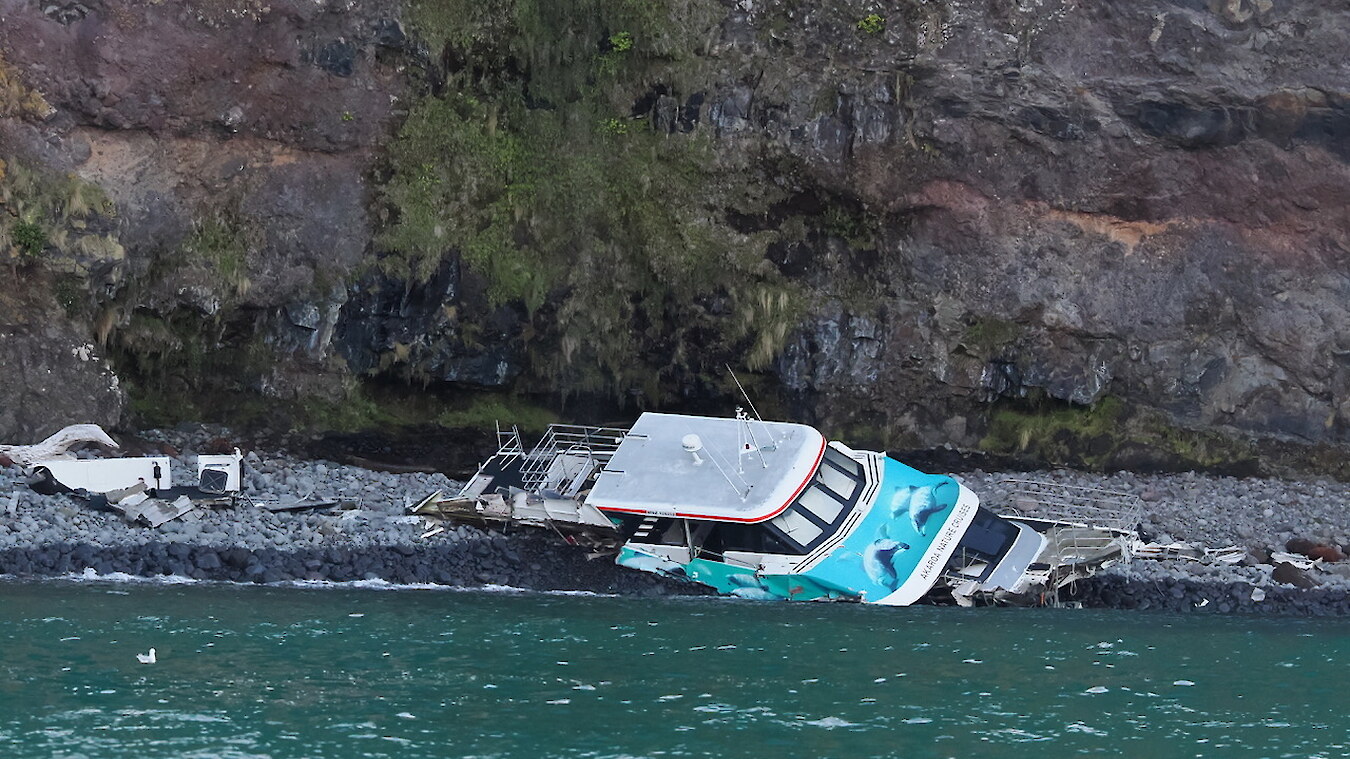
On 31 January a Black Cat Cruises catamaran grounded in Nikau Valley Bay in the Akaroa Harbour. Environment Canterbury has said it was likely that all the fuel on board the vessel had leaked into the water. This grounding and resulting discharge of oil and other debris such as rubbish and plastic gloves into the Harbour has brought to the fore the urgent need to review the use of the Harbour by commercial vessels. The area where the boat grounded is a marine reserve where an operator has reported seeing dolphins, penguins, seals and albatross, and is an important habitat for Hector’s Dolphins.
Hector’s Dolphins are only found in Aotearoa/New Zealand’s waters, and represent one of the world’s rarest dolphin species. It is classified as ‘Endangered’ by the International Union for Conservation of Nature, IUCN (Reeves et al. 2013) and ‘Threatened – Nationally Vulnerable’ by the Department of Conservation, DOC (Baker et al. 2019).
Research carried out over the past few years has consistently shown that vessel activity can pose serious risks to cetaceans, including Hector’s Dolphins. The Department of Conservation (DOC) reports that “Collisions with hulls or propellors of vessels can cause injury or death. Motorised vessels can be a major source of noise pollution that may displace cetaceans from their preferred habitat. The presence of vessels may change cetacean behaviour in ways that disrupt behaviours critical for their survival (Rolland et al. 2012). Indirectly, the anchoring and manoeuvring activities of vessels may degrade habitats that cetaceans rely on (Broad et al. 2020). These risks can be made worse by vessels actively seeking interactions with cetaceans for tourism.” (DOC 2024).
These effects from the presence of vessels can cause displacement from the dolphins’ core habitat. DOC also reported that “The distribution of dolphins in the harbour has shifted southward and contracted between 2000 and 2011, and 2012 and 2020” with this shift occurring at the same time as annual cruise ship visits quadrupled. (DOC 2024). Ambient noise is increased by cruise ship presence (e.g., Frankel and Gabriele 2017).
A study of short-term behavioural responses of Hector’s dolphins to vessels showed that dolphins spent significantly less time diving and travelling when vessels were within 300 metres with a resulting likelihood of altered foraging success. Dolphins also showed significant behavioural changes when swimmers were present in the water (Martinez et al., 2011).
Dolphins are present year-round in Akaroa Harbour with their distribution concentrated close to shore in the summer months (Dawson et al., 2013), coinciding with calving (Slooten and Dawson, 1994) and the seasonal peak in tourism. Vessel traffic has increased substantially in Akaroa Harbour over the years. Stone and Yoshinaga (2000) reported a doubling in recreational vessel traffic during the 1990s and in 2021and Carome reported that vessel traffic during the summer had doubled since then with the largest proportion of this increase being commercial dolphin tourism (Carome 2021).
The Department of Conservation (DOC) has estimated that about half of the Hector’s dolphins in the Te Pātaka-o-Rākaihautū / Banks Peninsula population use Akaroa Harbour at some point during their lives. It reports that the “dolphin tourism industry operates almost exclusively in Akaroa Harbour and in waters immediately outside the harbour entrance. Recreational vessel traffic probably exists in the harbour at higher densities than anywhere else on Te Pātaka-o-Rākaihautū / Banks Peninsula. Therefore, a relatively large proportion of the Te Pātaka-o-Rākaihautū / Banks Peninsula dolphin population is exposed to intensive tourism and recreational boating pressure.” (DOC 2024).
In 2021 DOC set new limits across the six permitted dolphin watch and swim operators of 20 trips per day over the summer months and no more than 12 trips per day for six months of the year. However, these limits are no longer sustainable, particularly with the additional risk of grounding or capsizing of vessels.
As DOC’s Operations Manager has said “We need to protect the dolphins from too much disturbance so they can forage and rest, and to avoid pushing them further out of the harbour. A healthy dolphin population will help ensure the long-term sustainability of the local dolphin watching industry and cultural and environmental values of Akaroa Harbour.”
References
Baker CS, Boren L, Childerhouse S, Constantine R, van Helden A, Lundquist D, Rayment W, Rolfe JR. 2019. Conservation status of New Zealand marine mammals, 2019. New Zealand Threat Classification Series 29. Wellington: Department of Conservation. 18 p.
Broad A, Rees MJ, Davis AR. 2020. Anchor and chain scour as disturbance agents in benthic environments: trends in the literature and charting a course to more sustainable boating and shipping. Mar Pollut Bull. 161:111683.
Carome WJ. 2021. Examining the relationship between tourism and Hector’s dolphins (Cephalorhynchus hectori) at Akaroa Harbour [master’s thesis]. Dunedin: University of Otago.
Dawson, S., Fletcher, D., and Slooten, E. (2013). Habitat use and conservation of an Endangered dolphin. Endanger. Species Res. 21, 45–54. doi: 10.3354/esr00508.
Department of Conservation, 2024.Long- and short-term impacts of vessels on Hector’s dolphins (Cephalorhynchus hectori) at Te Pātaka-o-Rākaihautū / Banks Peninsula.
Frankel AS, Gabriele CM. 2017. Predicting the acoustic exposure of humpback whales from cruise and tour vessel noise in Glacier Bay, Alaska, under different management strategies. Endanger Species Res. 34:397–415.
Martinez E, Orams MB, Stockin KA. 2011. Swimming with an endemic and endangered species: effects of tourism on Hector’s dolphins in Akaroa Harbour, New Zealand. Tourism Rev Intl. 14:99–115.
Reeves R, Dawson SM, Jefferson TA, Karczmarski L, Laidre K, O’Corry-Crowe G. 2013. Cephalorhynchus hectori. The IUCN Red List of Threatened Species; [accessed on 01/02/2023]. https://www.iucnredlist.org.
Slooten, E., and Dawson, S. M. (1994). “Hector’s Dolphin,” in Handbook of Marine Mammals Vol. 5, (Delphinidae and Phocoenidae), eds S. H. Ridgway and R. Harrison (New York, NY: Academic Press), 311–333.
Stone GS, Yoshinaga A. 2000. Hector’s dolphin Cephalorhynchus hectori calf mortalities may indicate new risks from boat